
 Elang Resto OS
 Run your restaurant — from the table to the balance sheet.
Elang Resto OS (“Eros”) brings the cashier & shifts, the kitchen display, self-ordering via kiosk & table QR, recipes and food cost, stock & purchasing, face attendance & payslips, and double-entry accounting into one multi-branch app. We set it up & maintain it on your own server; your data, exportable anytime.
From the table to the kitchen, without shouting
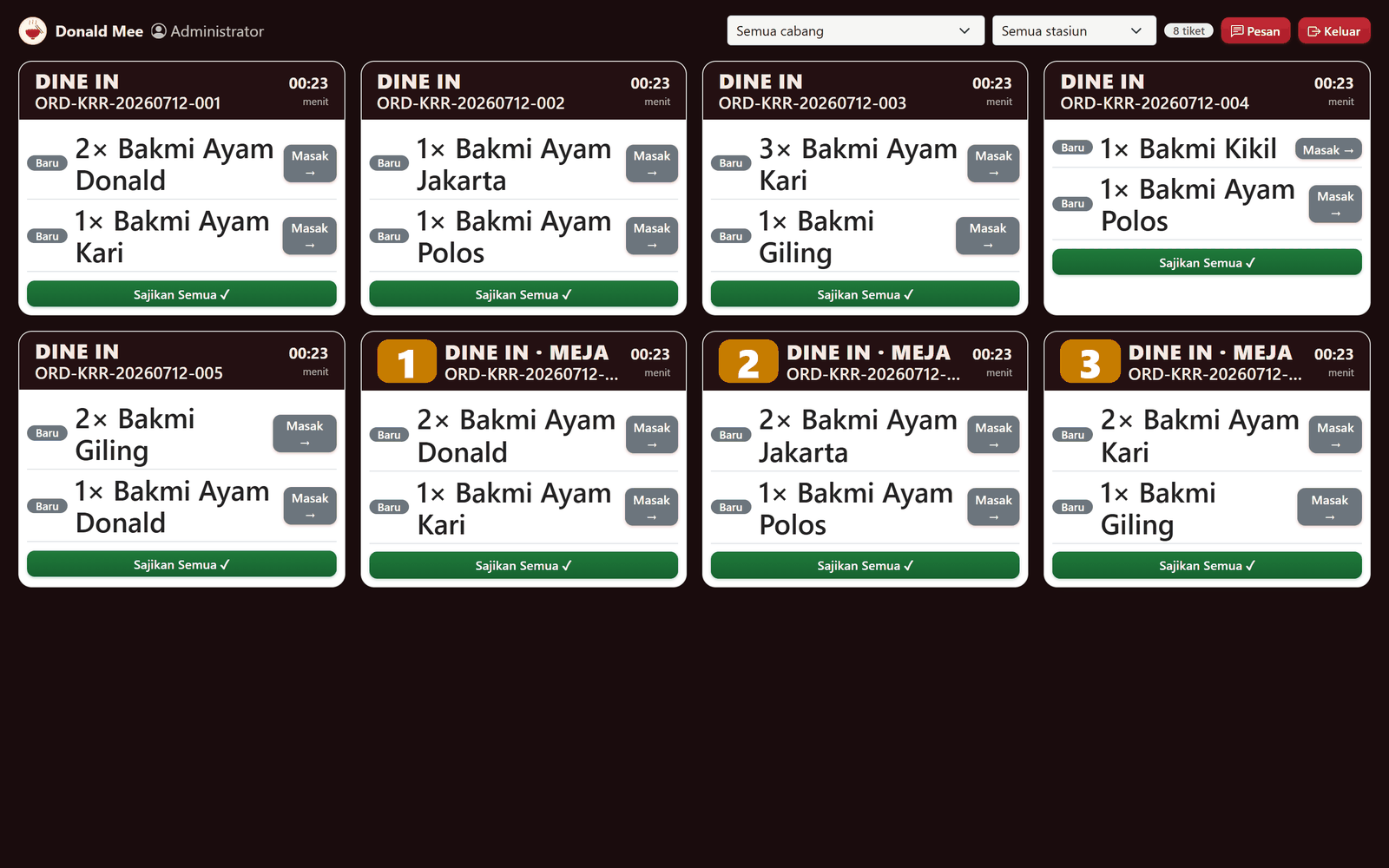
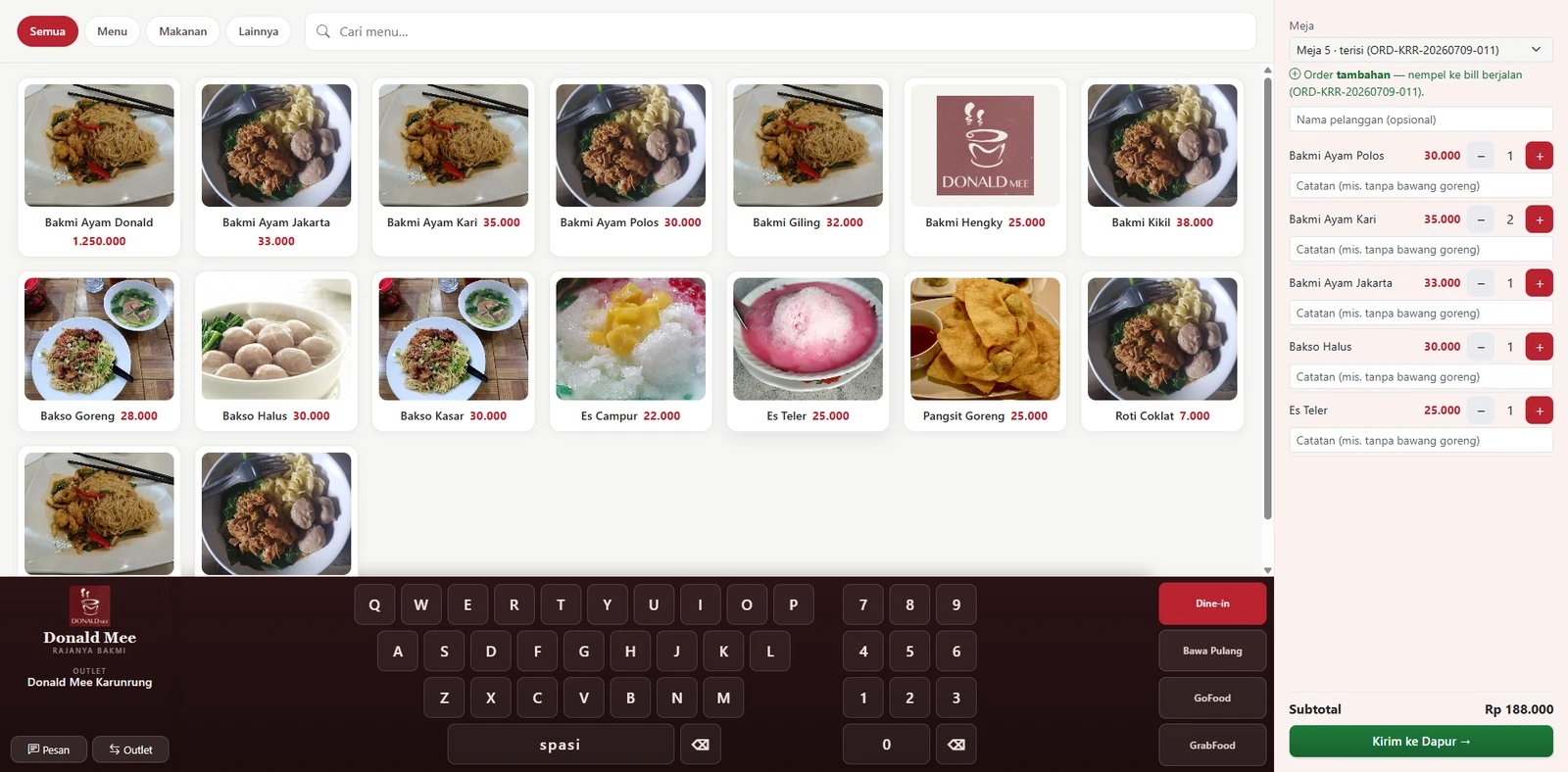
The waiter takes the order on the Order screen and signs it with a PIN. The ticket appears instantly on the kitchen display — no reload, split by cooking station — and prints on the kitchen printer. Follow-up orders attach themselves to the same table bill until the guest pays at the register.
Dough, broth, or spice bases are made as work-in-progress items, then reused across many dishes. Each plate computes its own cost.
A Face-ID kiosk logs arrivals & lateness (still-photo proof), payslips are built from that attendance, and posting them journals straight into the books.
Not just sales reports: automatic journals per transaction, payables/receivables, P&L, and a balance sheet per branch.
Four ways a guest can order — all land on one bill
Served by a waiter, self-ordered at a kiosk, scanned from a table QR, or grabbed as takeaway — everything funnels into the same kitchen and the same cashier.
Dine-in (waiter)
- Table
- Order
- Kitchen (KDS)
- Cashier
- Pay & receipt
Follow-up orders automatically join the same table bill until it’s paid.
Kiosk (pay first)
- Kiosk
- Pick menu
- Queue number
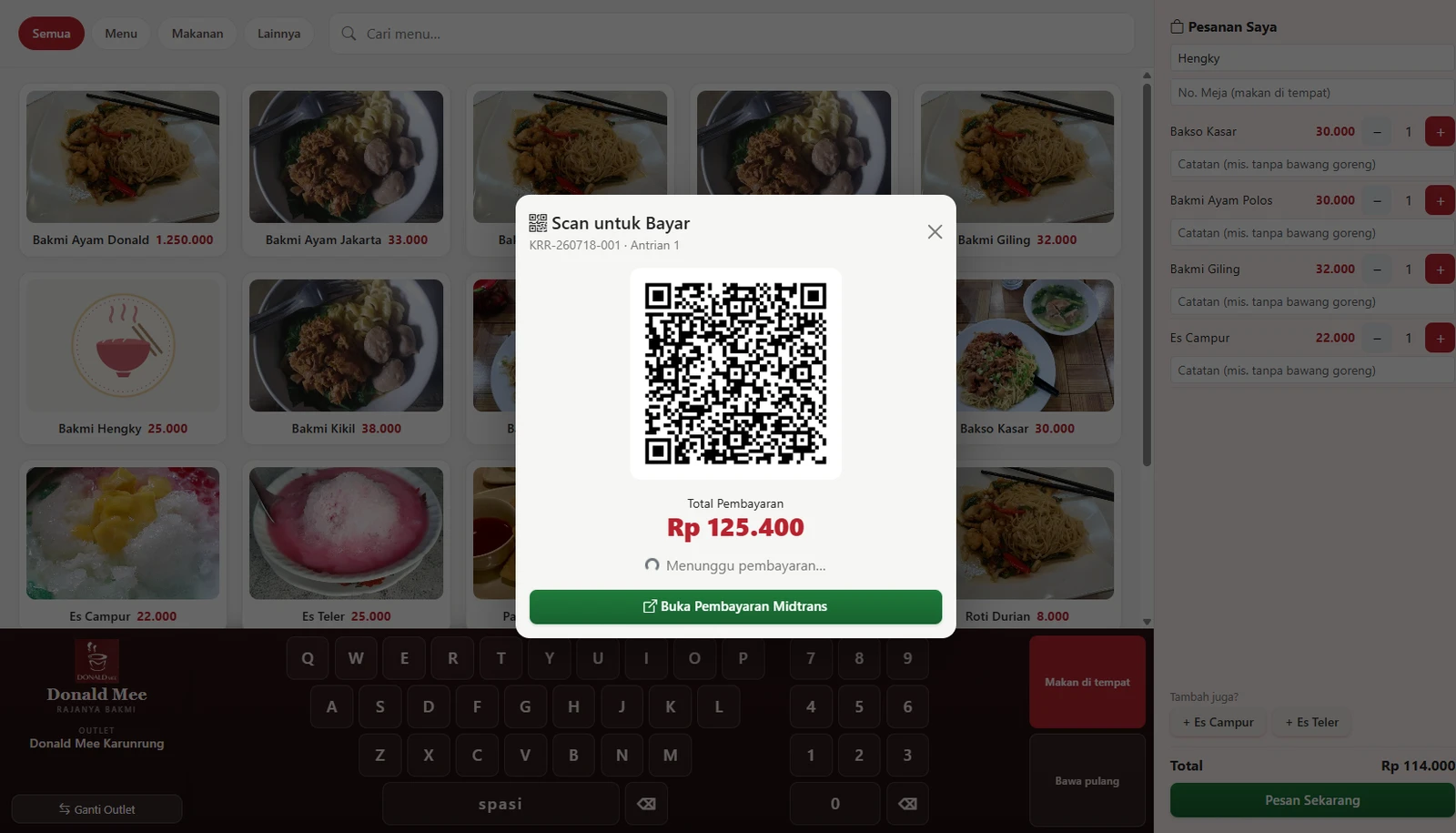
- Pay by QRIS
- Sent to kitchen
The order is only released to the kitchen once the QRIS payment clears.
Table QR
- Scan the table QR
- Menu on the guest’s phone
- Joins the table bill
- Pay at the cashier
Guests add their own orders without flagging down a waiter.
Quick takeaway
- Cashier
- Pick menu
- Pay
No table — including GoFood & GrabFood orders, recorded as receivables.
As deep as an ERP, as fast as a register
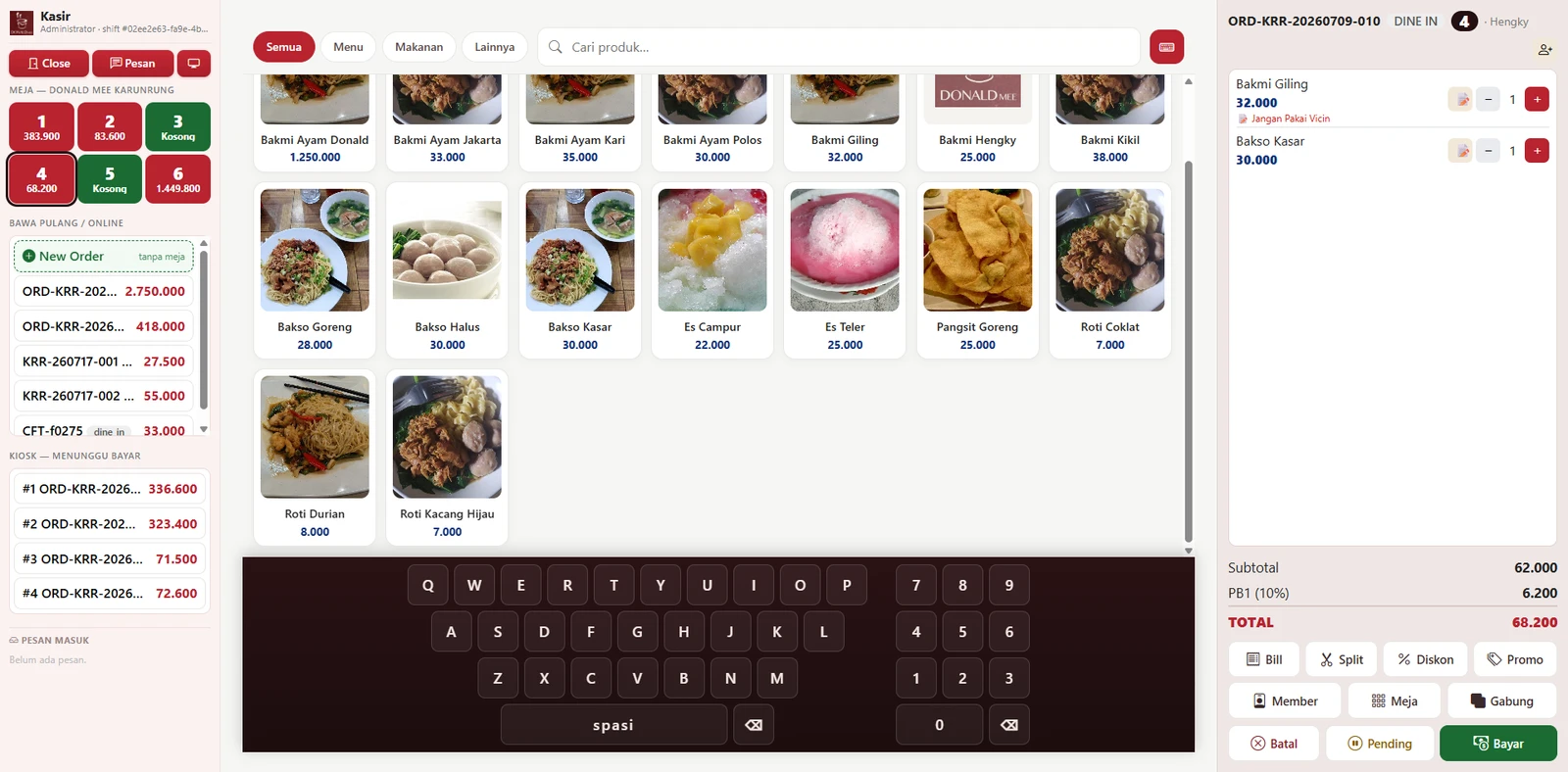
Cashier, Tables & Shifts
- ✓One screen: table board, menu, bill panel & numpad
- ✓Open a shift with opening cash + manager PIN approval
- ✓Split bills, merge bills, move tables, print a provisional bill
- ✓Take cash, QRIS, debit/card, transfer — split payments supported
- ✓Shift close: count cash by denomination → any variance surfaces automatically
Kitchen Display & Order Screen
- ✓Real-time kitchen tickets, no reload — waiting → cooking → ready → served
- ✓Filter by branch & by station (e.g. Noodles, Drinks, Fried)
- ✓An alarm sounds when a ticket passes its max prep time
- ✓A dedicated waiter Order screen: take orders, no access to payments
- ✓Waiters identify themselves with a station PIN when sending an order
Kiosk, Table QR & QRIS
- ✓Self-order kiosk: pick outlet, cart, drink/dessert suggestions
- ✓Dine in or take away → the guest gets a queue number
- ✓QRIS payment via Midtrans (a simulation mode is available for trials)
- ✓A QR sticker on each table → the menu opens on the guest’s phone
- ✓Items ordered from the QR drop straight onto the running table bill
Recipes (BOM), Production & Food Cost
- ✓Recipes link a dish to its ingredients — for costing & stock deduction
- ✓Work-in-progress items: dough/broth made once, reused across many dishes
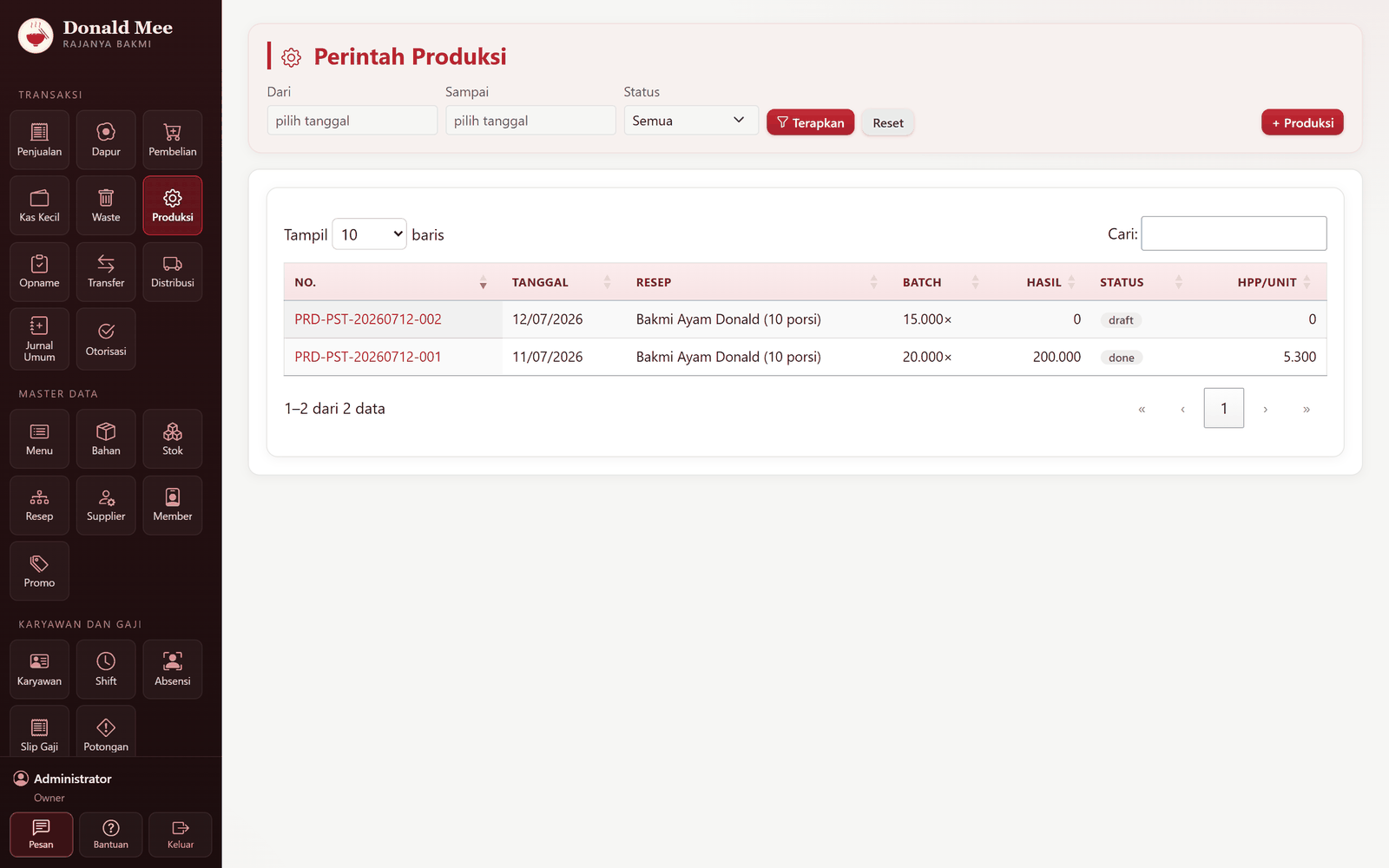
- ✓A production order shows ingredients needed vs stock on hand
- ✓On completion → ingredients consumed, output stocked, unit cost computed
- ✓Per-dish profitability: margin, margin %, quantity sold, contribution
Inventory, Purchasing & Distribution
- ✓Multi-branch & multi-warehouse stock, batches + expiry (FEFO)
- ✓Reorder points & low-stock warnings on the dashboard
- ✓Stock cards with running balances, stock takes, waste & adjustments (journaled)
- ✓PO → approve → receive goods: stock rises, payable & journal created automatically
- ✓Central kitchen → outlet distribution: request → approve → ship → receive
Staff, Attendance & Payroll
- ✓Face-ID attendance kiosk: voice greeting, on-time/late, anti still-photo check
- ✓Work shifts & lateness tolerance — the shift is inferred from arrival time
- ✓Pay components: base, allowances, meal & transport per day present, BPJS
- ✓Deductions (loss/damage) can be split evenly across several staff
- ✓Payslips computed from attendance, printed, then posted → payroll journal
Members, Promos & History
- ✓Members: points, cashback wallet, automatic tier (Bronze/Silver/Gold)
- ✓Points & cashback accrue when an order is paid, spendable at the register
- ✓Promos: percentage, amount, or BOGO — with minimum spend & happy hour
- ✓Sales history: filter by branch/type/date, view & reprint receipts
- ✓Authorization & Void Log: who voided, who approved, and why
Accounting & Reports
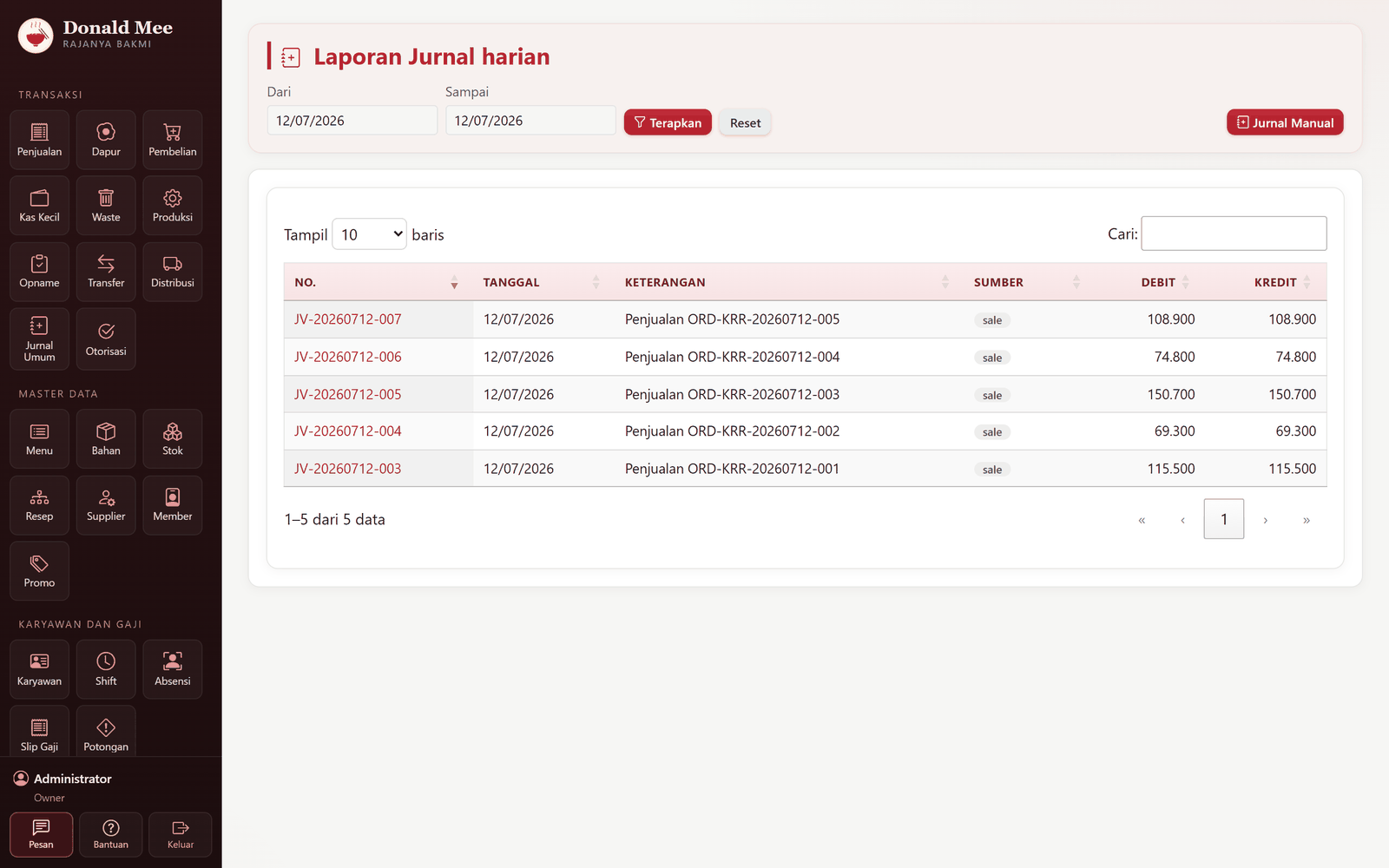
- ✓Automatic journals from sales, purchasing, production & payroll
- ✓Supplier payables (AP) & online-channel receivables (AR) — settle with commission
- ✓Ledger, trial balance, P&L, balance sheet — consolidated or per branch
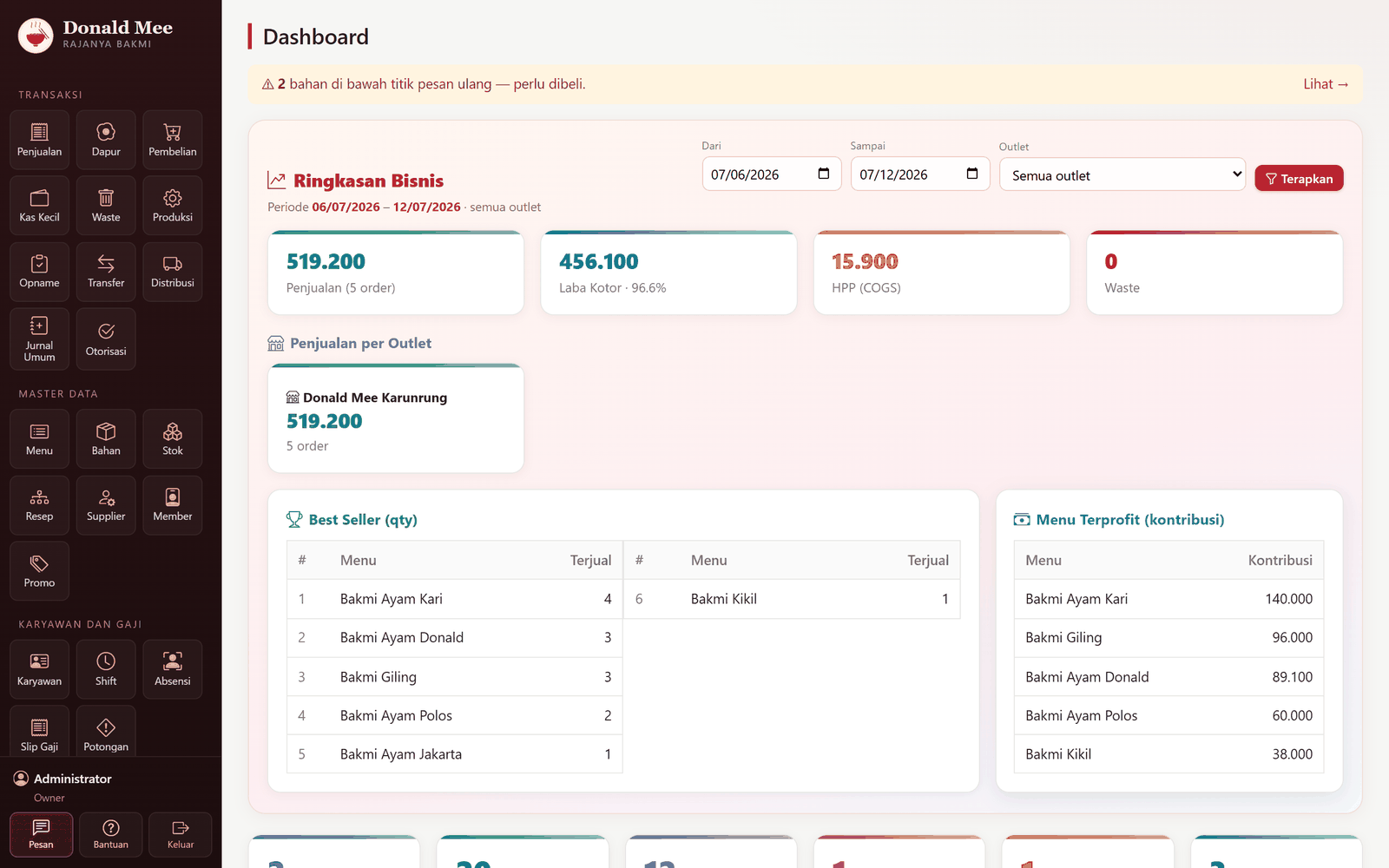
- ✓Owner dashboard: revenue, gross profit & margin, food cost, best sellers, top-profit dishes
- ✓Sales reports (PB1 tax & service charge), membership, and promo usage
See the real Elang Resto OS
Actual screenshots straight from the app — not mockups.
Every plate knows what it cost
Recipes (BOM) tie each dish to its ingredients — including semi-finished ones like dough or broth reused across many variants. As soon as production completes or an order is paid, stock is deducted and the cost computes itself using moving average. Profit per dish becomes a number, not a guess.
Cash and stock don’t quietly disappear
Restaurants rarely leak from one big theft — they leak from many small gaps. Eros closes them with a clear trail.
Remote void authorization
A cashier can’t void a bill at will — they request, a supervisor approves from their own screen. It all lands in the Void Log: who, when, and why.
Shift close by denomination
Physical cash is counted from Rp100,000 down to Rp100 and compared against cash sales. Any variance shows up on the closing report, not at month end.
Recycle Bin & audit log
Deleted master data goes to the Recycle Bin and can be restored. Deletion is refused while transactions still use it — and it stays on the record either way.
Journaled waste & stock takes
Wasted ingredients and stock-take differences become rupiah in the books immediately. Shrinkage stops being a month-end mystery.
Built for businesses like these
- ✓Multi-branch restaurants, cafés & eateries that want one system all the way to the books
- ✓F&B businesses with a central kitchen distributing to outlets
- ✓Menus built on semi-finished bases — dough, broth, spice pastes — that need accurate costing
- ✓Busy restaurants looking to cut queues with a self-order kiosk & table QR
- ✓Owners who want real control: void authorization, cash variance, and an audit log
Frequently asked
How is this different from a normal restaurant POS?+
A typical POS stops at the sale. Elang Resto OS carries it through: tickets land on the kitchen display, recipes deduct stock and compute food cost, purchases create payables, face attendance becomes payslips, and everything ends up in double-entry journals — a P&L and a balance sheet, not just a sales report. No add-on modules billed separately.
How do hosting & data ownership work?+
We set it up and fully maintain it on your own server (VPS) — server, security, updates, and backups are our job. The monthly fee is fixed (server rental + maintenance), not a per-user or per-transaction charge that balloons as you grow. Your business data is yours and can be exported anytime.
Does it handle multiple branches and a central kitchen?+
Yes. Each outlet has its own tables, warehouse, and printers, and one outlet can be flagged as the central kitchen. The distribution flow is: the outlet requests → head office approves → head office ships (stock leaves FEFO) → the outlet receives. Reports can be viewed consolidated or per branch.
Which payments are supported?+
At the register: cash, QRIS, debit/card, and transfer — including split payments and change calculation. For the kiosk & table QR, QRIS payments run through Midtrans (a simulation mode is available for trials). GoFood/GrabFood orders are recorded as receivables and settled with their commission/fee.
What if my dishes use house-made dough or broth?+
That’s exactly where it shines. Dough, broth, or spice bases are registered as work-in-progress items and produced first, then used as a recipe component across many dishes at once. Adding a new variant takes just 1 filling + 1 dish + 1 recipe — you never rewrite the dough recipe, and each variant’s cost is computed automatically from the dough cost plus its filling.
What hardware do we need?+
Everything runs in the browser, so there’s nothing to install on each machine. You’ll want: a PC/tablet for the cashier & waiters, one screen (TV/tablet) for the kitchen, a LAN thermal printer per branch for kitchen tickets & receipts (IP address, port, and paper width are configured in Settings, with a test print), plus a touchscreen tablet if you want the kiosk and a camera if you want face attendance.
Related articles
All articles →
Elang Restaurant Software vs Cheap Café & Restaurant POS Apps
Why cheap café POS apps can be so cheap, what they leave out, and the 7 questions to ask any vendor before you choose restaurant software.
Why Restaurant Software Should Run in a Browser, Not as an Installed App
Browser-based restaurant software vs an app installed on every machine: updates, device freedom, kiosks & table QR, and what you actually need to prepare.
Why a Restaurant Needs a Restaurant OS, Not Just a POS App
A POS app records the money coming in. Restaurants leak in the kitchen, the pantry, and the payroll. Here is when your restaurant outgrows a cash register.
See Elang Resto OS in action
Request a free demo — we’ll walk you from the cashier & kitchen screens to the QRIS kiosk, per-dish food cost, and the financial reports.